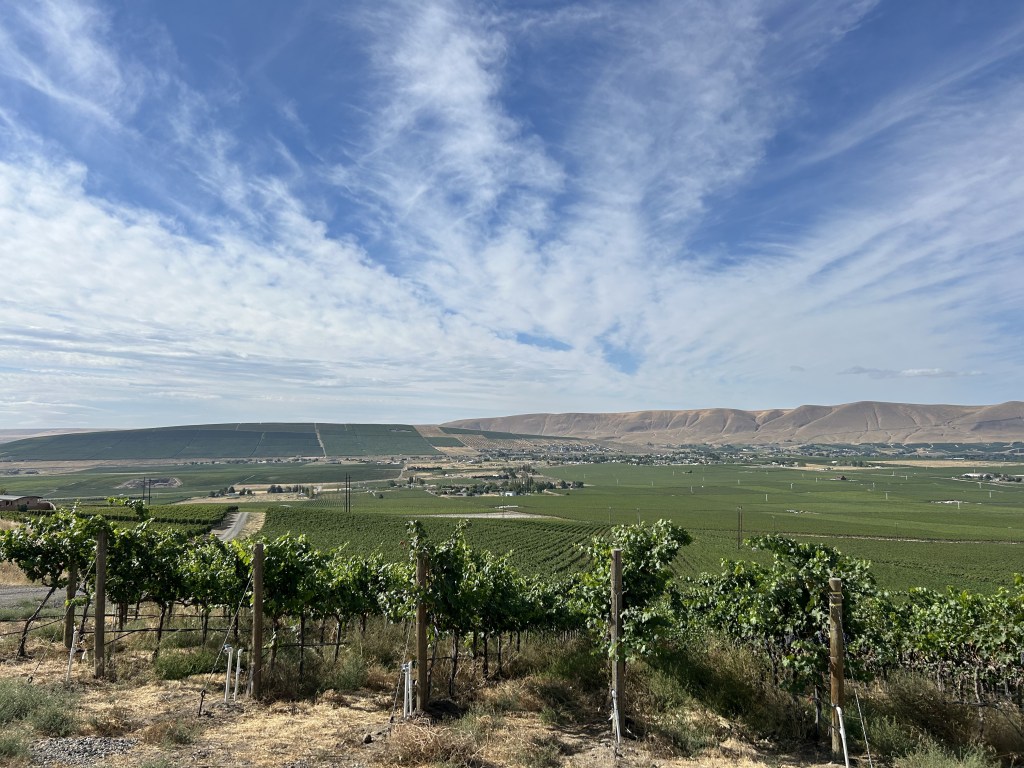
“Not to brag, but we’ve made people puke up here,” Canvasback winemaker Joe Czarny noted dryly on a morning in late August as he ambled along the upper ridge of Longwinds Vineyard.
My husband Toby, hospitality manager of the winery, had organized a field trip to the area for winery employees, and I was tagging along, rounding the total assembled to a group of 10.
But it wasn’t for lack of oxygen or fear of heights that could make people sick at Longwinds, Canvasback’s sole estate vineyard, managed by superstar Washington wine grower, Dick Boushey. We were standing at only about 1000 feet, and our trusty caravan of cars had deposited us there. It was the fairly steep upper stretches of the vineyard—in the wine business, after a night popping corks, or with too little sleep, it’s easy to see how one could easily become, well, winded.
Czarny was being funny—he is known for his very deadpan humor—but to me, the comment could have been a metaphor for what happens when you are transported from your everyday surroundings, like the somewhat sterile confines of a tasting room, to an entirely different environment, say, a dry and dusty vineyard—the contrast can be dizzying.

Longwinds is a made-up word for the vineyard, which was first planted in 2014 and produced its first vintage in 2016. “Winds” refers to the persistent wind of the Yakima River, winding its way along the valley floor below Red Mountain. “Long” is a reference to the vineyard’s unusually long vine rows. It’s planted mostly to cabernet, with some merlot and malbec. And, spanning 18 acres, it’s just a small slice of the Red Mountain AVA which totals 4,040 acres.
Just about 400 to 500 feet above us was the top of Red Mountain. At its height of 1500 feet, Red Mountain is more of a dramatic hill—in this particular case, what’s called an “anticline,” an ancient fold of earth originally laid flat, then reorganized into rolling mounds over the millennia by the earth’s movement.
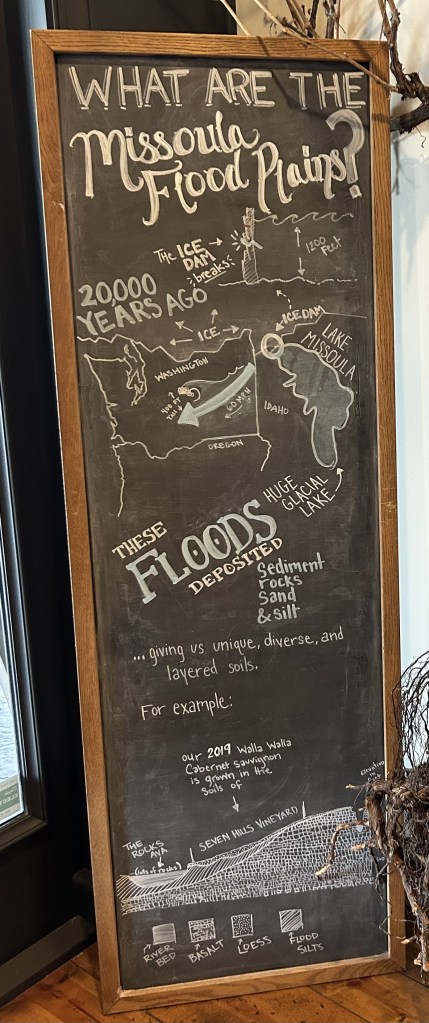
More geology lessons followed. Czarny motioned for us to look just beyond the parking area, where a cross section cut into the land revealed subterranean soil conditions—a profile, Czarny said, “developed through geologic events known as the Missoula floods…”

Most of the group knew about the floods, which have been written about extensively in many places. For lack of having to explain that here myself, this chalkboard illustration provides a very handy visual representation:
In Red Mountain’s hot, dry climate, the vines struggle, and the soils and prevailing winds are known to produce prized fruit with smaller berry sizes, tougher skins, and outsized tannins. Another benefit of such arid conditions is that mildew, mold, and root rot is rarely an issue.
Other benefits include little to no pressure from birds. “You’ll notice there are no bird nets anywhere,” Czarny said—this is due to Red Mountain’s lack of trees, a major attractant for birds. Likewise phylloxera, a growing concern throughout Washington state, hasn’t been much of an issue on Red Mountain, as phylloxera don’t thrive in thin, silty soils.
The group explored a few rows and picked some berries—the fruit was about “60% through veraison,” Czarny said.
While winegrowers can decide to pick based on a number of factors—brix, or sugar levels, being a chief indicator—Czarny said he likes to pick based on flavor. I ate some grapes and crunched on their seeds to see what I was able to ascertain, which was little beyond detecting sweet (grapes) and bitter (seeds).
“Signs of grape ripeness are things like skin consistency and texture, color, and seed ripeness and color, from green to brown, and bitter flavors,” Czarny said.
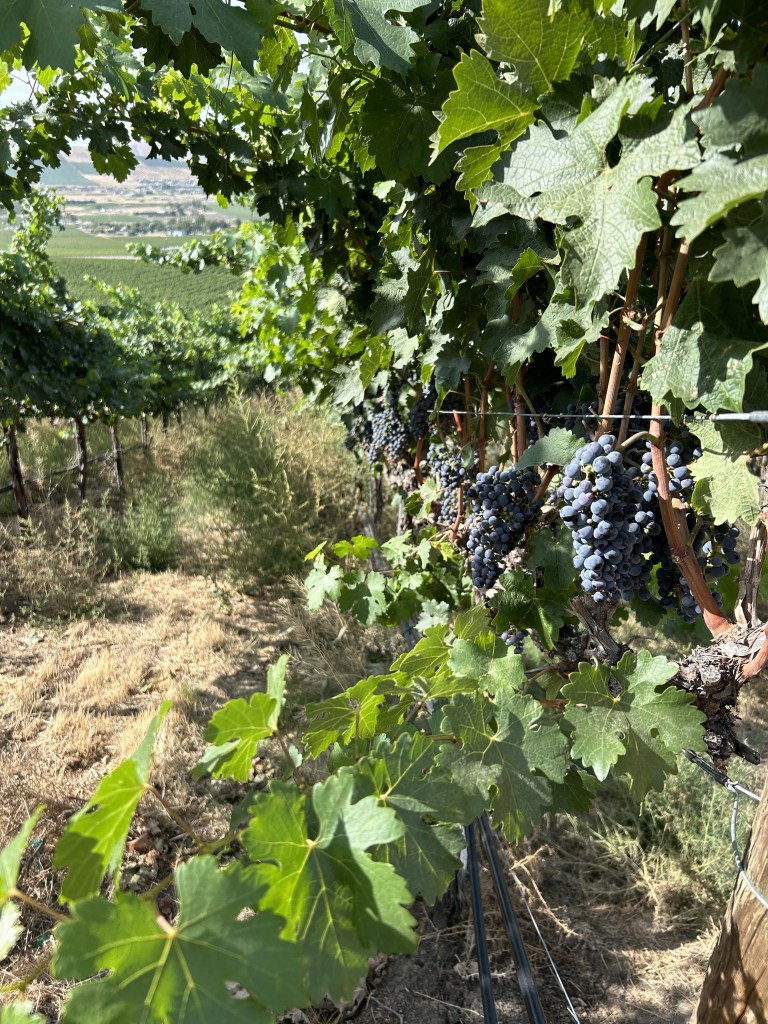
Because of the intense sun, the leaf canopy is carefully managed, cut back to expose more fruit on the morning side, and leafier on the afternoon side, to protect from harsh rays.
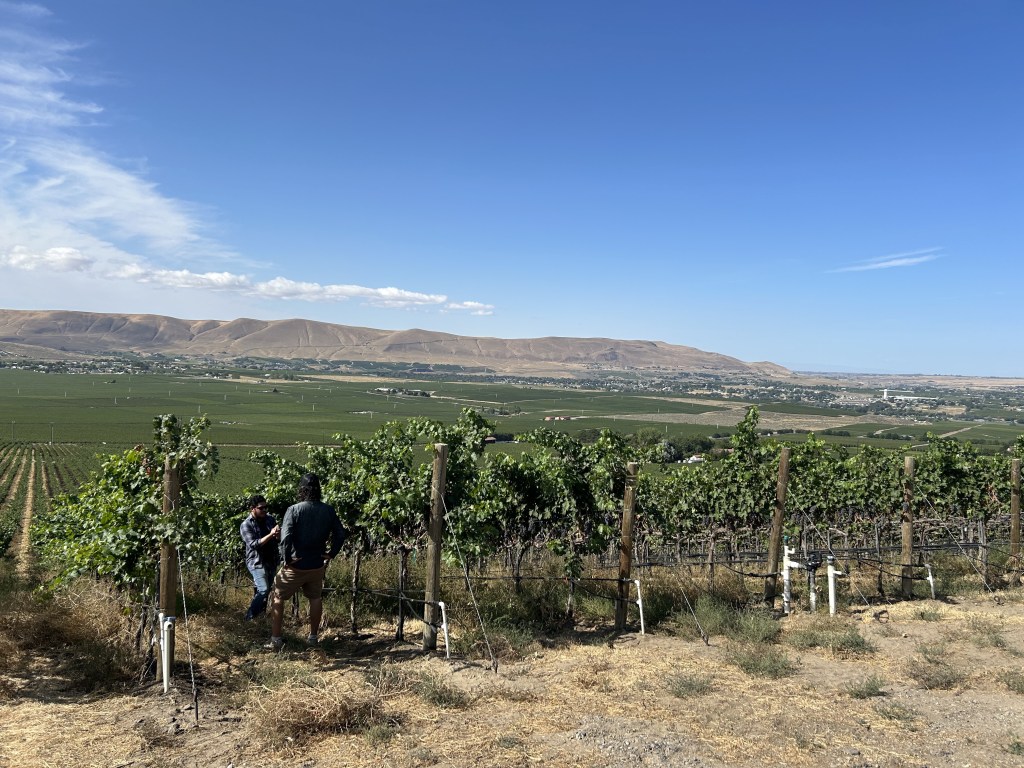
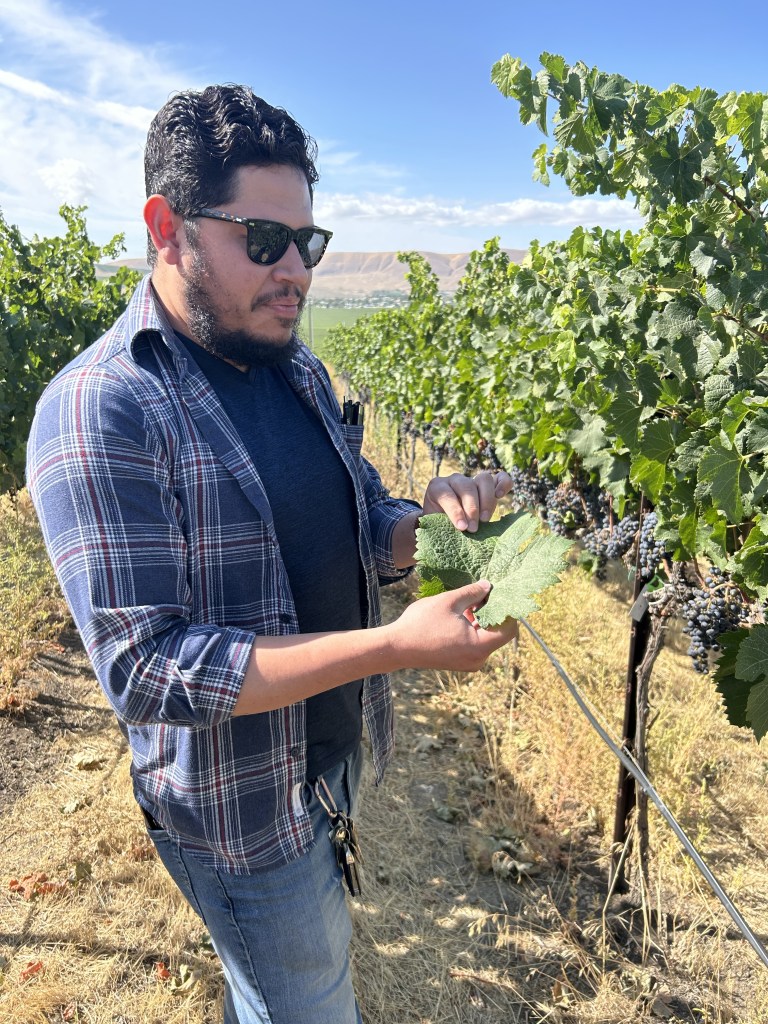
From here, we moved east and stopped at Block 2 of Quintessence vineyard, situated just adjacent to Col Solare and the source of Canvasback’s Grand Passage cabernet.
Czarny was excited to talk about the differences between the vineyards and their fruit, which he said is likely due to “lower elevation, flatter land” and possibly the clone [which I can not verify].
“Year in, year out, to be less than a half mile away [from Longwinds] and to create such different style of wine always amazes me,” Czarny said.
Aside to me, Toby explains the difference: “Longwinds shows more red fruit, softer tannins, while Grand Passage [Quintessence] shows the darker, black fruits.”
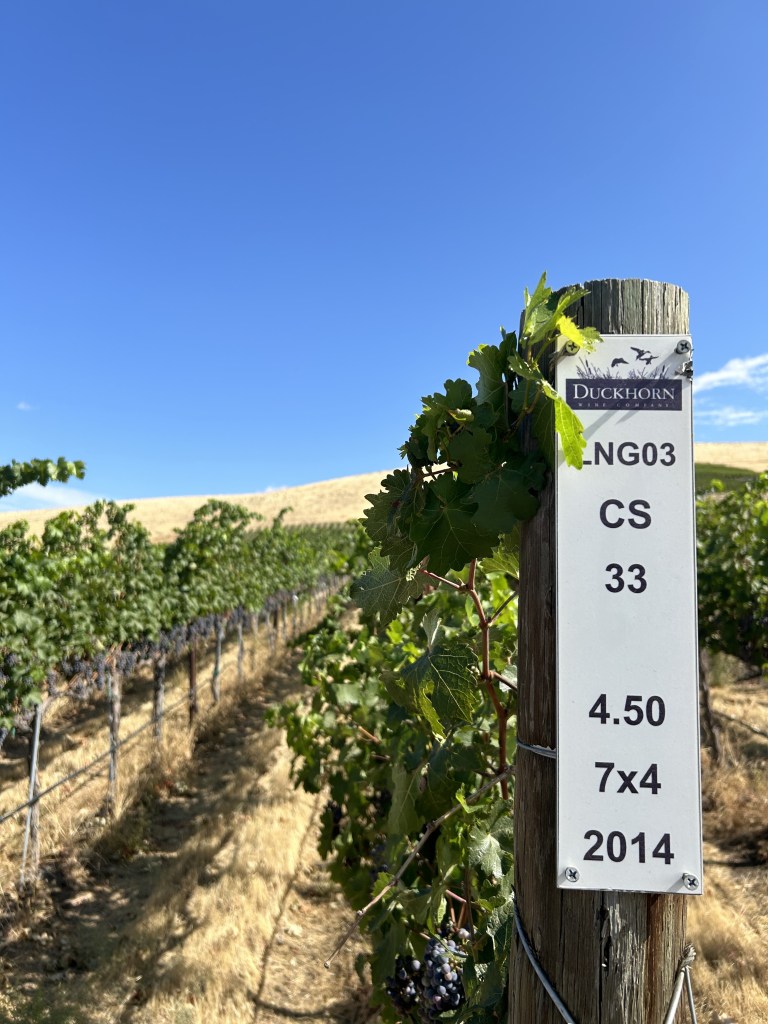
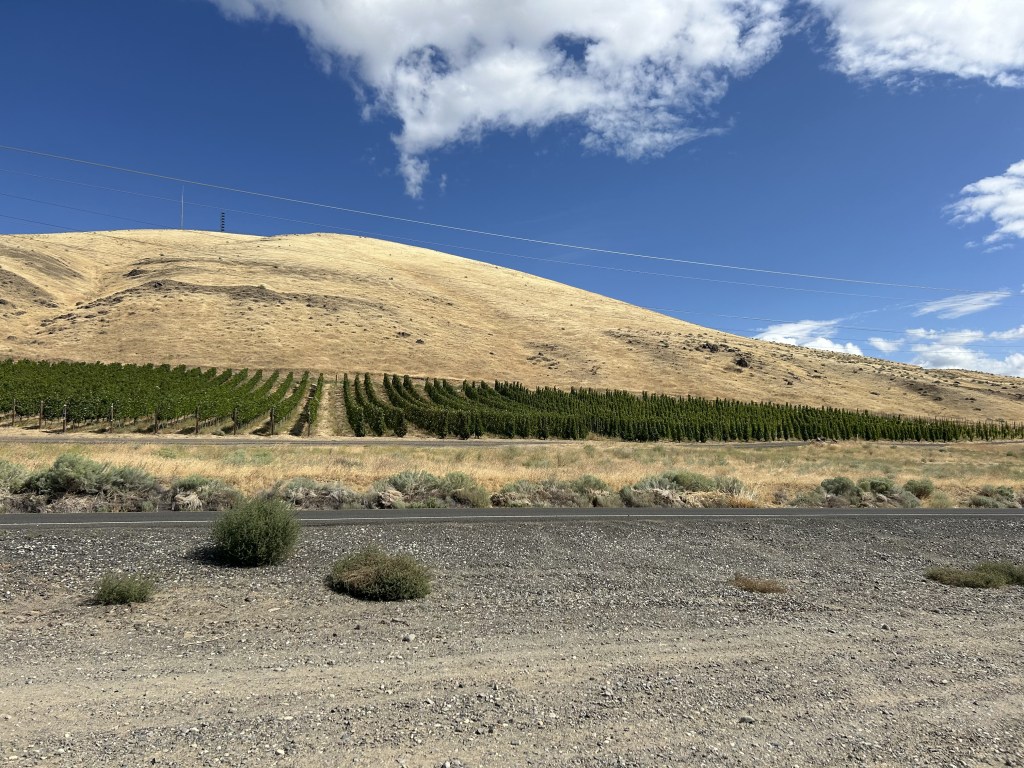
We packed in our cars and moved on to Ciel du Cheval. In between Longwinds (seen below to immediate left) and Ciel (across the road) we captured this:

(and Czarny to immediate left of sign, Garcia to immediate right.)
Canvasback sources some cabernet and merlot from Ciel du Cheval, as well as its cabernet franc.
“If you think cabernet franc is ready to pick, wait two weeks and then pick it,” Czarny advised.
Planted in the mid ’70s, it’s one of the oldest vineyards on Red Mountain.
I always wondered why “Ciel du Cheval,” which in French translates to “Sky of the Horse,” sounds unusually familiar to the AVA “Horse Heaven Hills.” Turns out, Ciel du Cheval was named as a playful nod to Horse Heaven Hills, as HHH, “the ridge that forms the southern border of the Yakima Valley and faces Red Mountain,” is clearly visible from Ciel du Cheval [Andy Purdue, Great Northwest Wine].
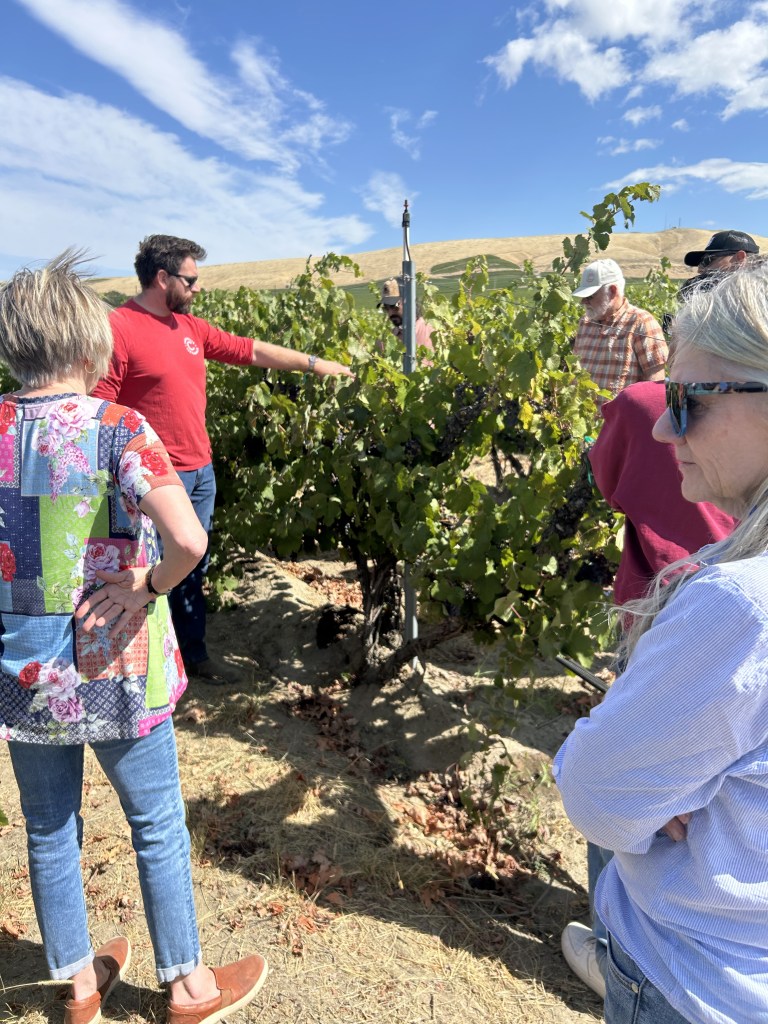
At Ciel du Cheval, Czarny noted some old vines had gone through a transformation—originally fan trained, they had been converted to VSP. This allowed winegrowers to restructure existing vines (in this case, petit verdot) without having to go through the extensive, years-long replanting process.
For our final vineyard, we motored on to Klipsun, another long-established Red Mountain site, planted in the early ’80s. It’s now owned by Terlato Wine Group, and managed by Boushey. It has been called “one of Washington state’s “first growth vineyards.”
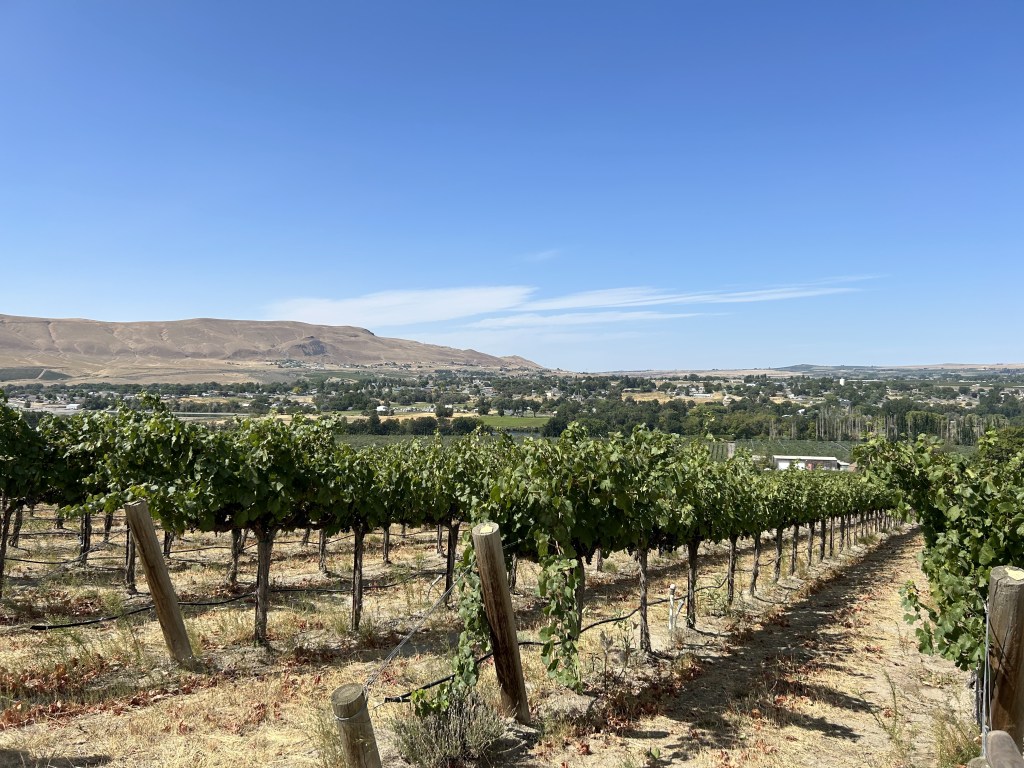
Canvasback sources cab and malbec, among other varieties, from Klipsun.
Czarny pointed out the vineyard’s rows—twice as wide by today’s standards, as tilling tractors have since become much smaller. Naturally, yields per acre are lower with wider spaced rows, which tends to put a premium on pricing.
The rows of the part of the vineyard we toured also run east to west, counter to the ideal north-south orientation. This makes them easier to manage on site’s steep west-facing slope—with rows planted this way, Czarny noted, “you just have to reconfigure the canopy management.”
Finally, Czarny shared a fun fact: Certain plants, such as lavender, or roses, are traditionally planted at the end of each vine row. Why? Because lavender, for example, attracts beneficial predatory insects to the vineyard, and roses, susceptible to similar diseases as grapevines, show the symptoms sooner than grapevines do, giving winegrowers a window to address the issue.
With that, we packed up back into our cars for lunch at the tasting room, a preview of the new 2021 releases from Red Mountain, and the gap between between tasting room and terroir, at least for me, a little less mystifying.
Previous Post: Wine, E-bikes, and Ween: My Summer (So Far) in 6 Degrees

 Gwendolyn Elliott
Leave a reply to Susan Cancel reply