
>>>>> Featured image: Stan Clarke vineyard, the largest of the E&V program’s teaching vineyards, was planted in the airport district in 2004.<<<<<
In “The Rootstock,” I pick up where I left off in Part I of my three-part series about the history and impact of the Walla Walla Community College’s Enology and Viticulture program. In this installment, I connect with some of the program’s earliest boosters, as well as faculty and staff that came later, for an overview of the factors that lead to its rise as the leading center for wine education in the state (some might say, the nation).
This has been such a fun and rewarding story to pursue, not just for all I’m learning—an archive’s worth of information, from the prestigious awards bestowed on the program, to many more influential people and personalities involved that couldn’t be squeezed in to the story—but because it’s a piece I’ve been wanting to dig into since moving here, when it seemed suddenly everyone I was meeting, or that I was hearing or reading about, had been involved with “the program.”
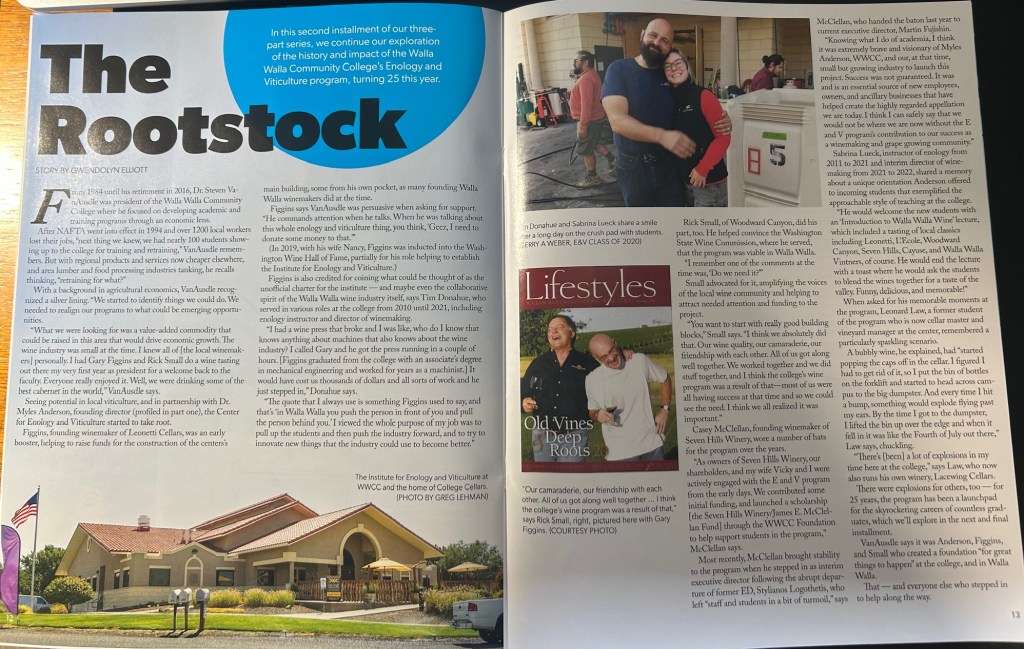
I’ve also been greatly encouraged to reflect on the spirit of cooperation and collaboration—and all the wonderful prosperity and progress it can bring to a community—that is central to the Walla Walla winemaking industry. As I learned, Gary Figgins is known for saying:
In Walla Walla, you push the person in front of you, and pull the person behind you.
I wasn’t able to include it in the story, but I asked Figgins about that quote (Tim Donahue first repeated it to me), and he spoke about it as the “secret sauce.” Then he went on to share another expression he’s fond of.
“I always use this analogy, you have this glass of wine that’s nestled in your palm. If you take care of what’s in that glass, everything around it is just superfluous fluff. If you take care of everything, all the combinations that go into making that wine the best that it could possibly be, that’s going to take care of you.”
Figgins was talking objectively about wine, and focusing on quality when it comes to weathering the peaks and valleys of the wine business. But I couldn’t help considering other applications of the idea, as I think it speaks to themes and topics that are much larger these days. For all the “superfluous fluff” facing us these days, whatever fills your glass, I hope you’re taking care of it.
Read Part 1: Myles Ahead, and Part II: The Rootstock. And stay tuned for Part III, currently in progress. Incidentally, the April issue of Lifestyles is the final issue of the magazine, so my next and last installment of the series will run likely later this month or early next month in the Explore section of the newspaper, where my column will be subsequently published.
As always, I’ll keep you posted here. And I appreciate you reading along!


 Gwendolyn Elliott
Leave a reply to Gwendolyn Elliott Cancel reply