
>>>>>Featured image: Toby walking the Winery Trail in beautiful Cowiche Canyon Preserve.<<<<<
Dear Wine Writers,
Is it possible?
a review that assesses
wine, without a score?
could wine reviews be:
poems, musings, Proustian-
like remembrances?
denoted by signs,
emojis, colors, symbols?
not by a number?
– Wondering in Walla Walla

I have wondered if my aversion to scored wine reviews has anything to do with the fact that I am hopeless at math. Numbers have always been so abstract to me—this language of agreed-upon symbols endlessly giving and taking. To me, it’s always been easier to understand concepts with words and explanations. Just pulling off the 5-7-5 syllable template in a haiku feels slightly heroic to me—the rare exercise where I willingly combine math and words.
(Seriously, though: Does anyone know what the “CE” button does on a calculator? Asking for a friend.)
I get that a neat, low-character-count figure like “95,” when it comes to wine, is easy to grasp—we learned how numbers apply to quality and understanding early in school (this is the system, in fact, that wine critic Robert Parker modeled his 100 point scale after. Sidenote: Can anyone guess what classes I got really good—and really bad—grades in?)
But somewhere along the way these scores became shorthand for the writing itself—the actual written assessment of the wine.
I’ve heard that consumers have been trained to look for a number, producers have been trained to desire them, writers have been trained to spin them up, and it would be next to impossible to rewrite the language of wine reviews in a way that serves anyone better than what we have now. That no one reads any more. That readers and consumers are busy, and need a grab-and-go visual cue that’s instantly understandable regarding a wine’s worthiness.

But I have to wonder—who is this system helping? If consumers now for the most part just look for a number—and producers eagerly supply high ones when they have them—what are busy, bewildered, frazzled wine shoppers actually learning about wine?
And if that—helping consumers learn about wine—doesn’t matter to wine producers and writers, well, perhaps what we have then is a failure to communicate. (This is a dramatic example, but it’s worth noting who was on the issuing, and receiving end, of this famous line in classic movie history.)
Because why wouldn’t anyone want to help the consumer, who is interested enough in wine to still be buying it, want to learn more about wine?
Oh wait, I know: Because wine is serious. Wine is hard. Most people wouldn’t understand. Wine isn’t for the average person. Wine is for people who already understand the system. And naturally, the super elites.
"It's big / Much bigger than you / So shut your silly mouth because there's nothing you can do / About the system / The bloody system / The intricate inner workings / Of the system" – "The Intricate Inner Workings of the System," The Bug ClubHyperbole much?
As I was scrolling rescued otter videos on Instagram recently, I came across an interesting post.

I wonder what other specific qualifications said billionaire has to be imparting lessons about wine. Is being a billionaire the point?
Certainly part of the debate about the utility and credibility of the wine rating system, which is not new, is of messaging. What is being communicated with the score, who is calibrating it, how is it determined, what is the voice of the publication issuing it?
People have long been frustrated by everything from the appearance of favoritism with certain brands and producers and “pay-to-play” reviews, a lack of transparency about the review system being used, the sense of entitlement expressed by some critics (often in person, expecting special treatment), conflicts of interest or existing friendly relationships between the winery and critic, requested expensive bottles being submitted for review, never to be published, even the lack of gender representation among wines (made by women) submitted to be scored (by men).
It’s worth noting that while plenty of women write about wine, according to a 2018 Wine Writer Survey, men are more likely to review wines in their writing, and are “significantly more likely” to use the 100 point rating scale in their reviews.
To me, ultimately, it’s a confusing, hypocritical, patronizing mess. It often still feels like an old boys club to me. And in spite of the fact that I really have nothing better to propose, I feel that there’s got to be something better out there.
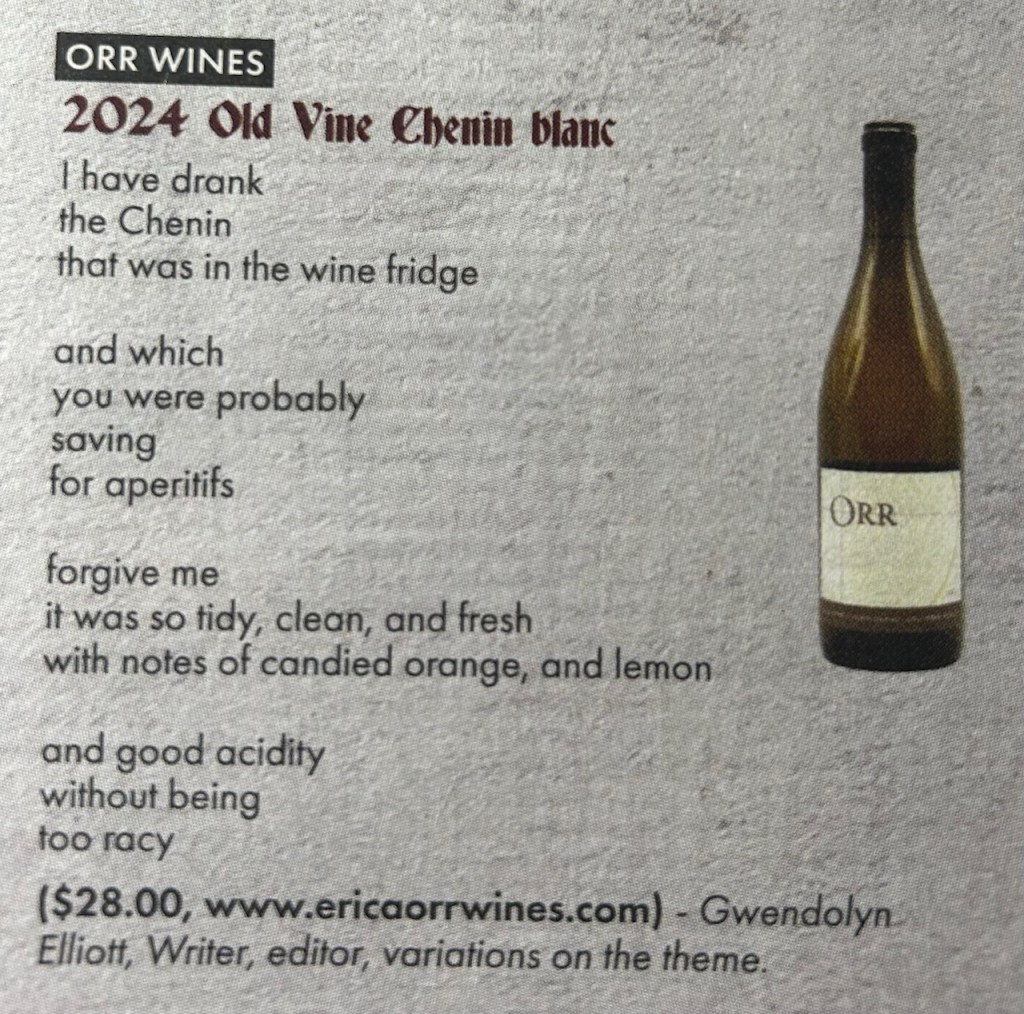
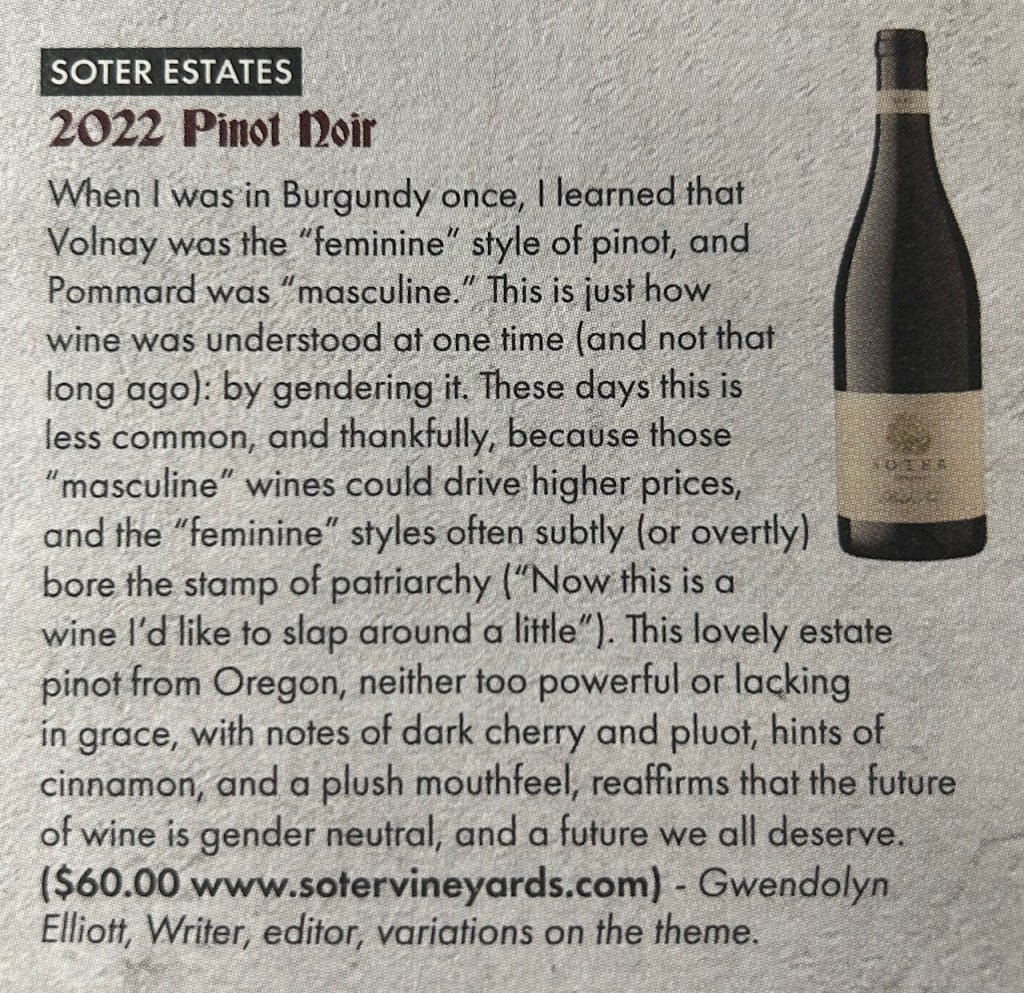
>>>>>Above and below: Recent, irreverent, playful, tongue-in-cheek, yet hopefully-somewhat-still-practical? wine reviews for Blood of Gods.<<<<
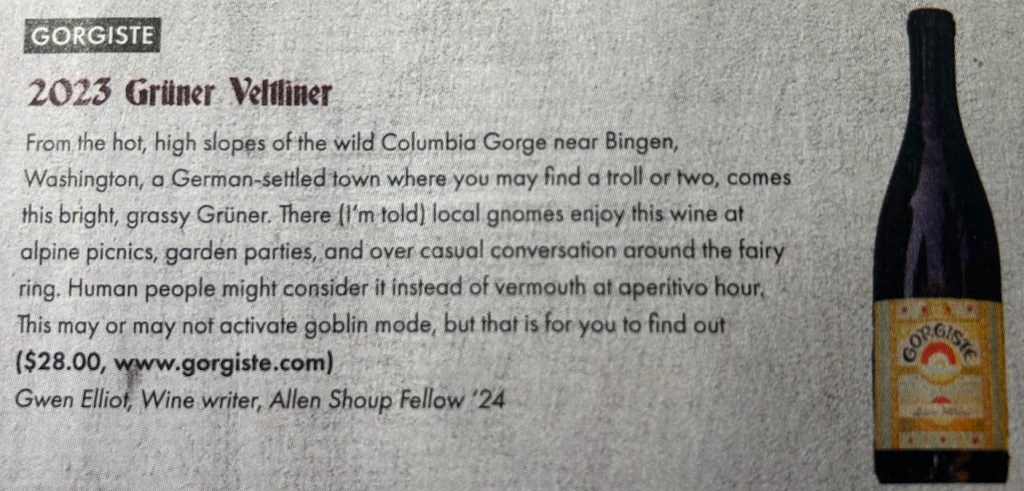
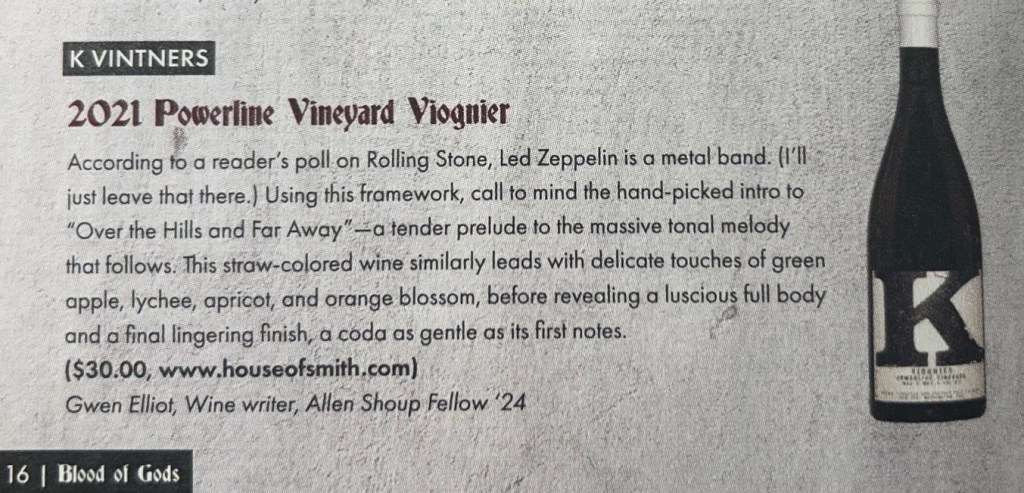
When I think of possible new paradigms in wine writing, I try to keep in mind that people do already (and still) read, maybe not long-form as much (*Cue the sound of me stifling an anguished cry*), but snacky information, anyhow: Trader Joe’s shelf-talkers, blurbs, and social captions; memes, menus, billboards, Yelp reviews, the comment section, ads; Highlights, headlines, sub headings, bulleted lists, pull quotes, the table of contents, etc.
Could such unconventional formats offer a short-form, numeral-free alternative to wine scores? It’s something that I have been playing around with in my own little way.
Serious wine people may say these reviews won’t help consumers grasp wine. That they won’t help wineries because wineries want scores they can market. That they lack integrity, or fail to honor the tradition or the craft of wine with depth. That they’re too silly or playful.
But, again, why is “seriousness” the default here? (*Interestingly, out of curiosity, I asked publisher Stacy Buchanan if any of the wine producers featured in the review section of Blood of Gods use the review to market their wine in some way, and he said some have! I’m trying to dig up a few as examples—stay tuned.*)
Ultimately as a writer, a terrible math student, and a notoriously loud typer, I have no choice but to firmly push the rating system aside (Get thee back, vile digits!) plonk out words on my abused MacBook, trust in my ability to communicate important concepts—and have faith that interested readers are capable of receiving them.
With this, I leave you on a silly note, because I can not help myself, and I love to laugh. How I wish more wine coverage could be this funny, creative, different…interesting.


 Gwendolyn Elliott
Leave a reply to Steve Kilisky Cancel reply