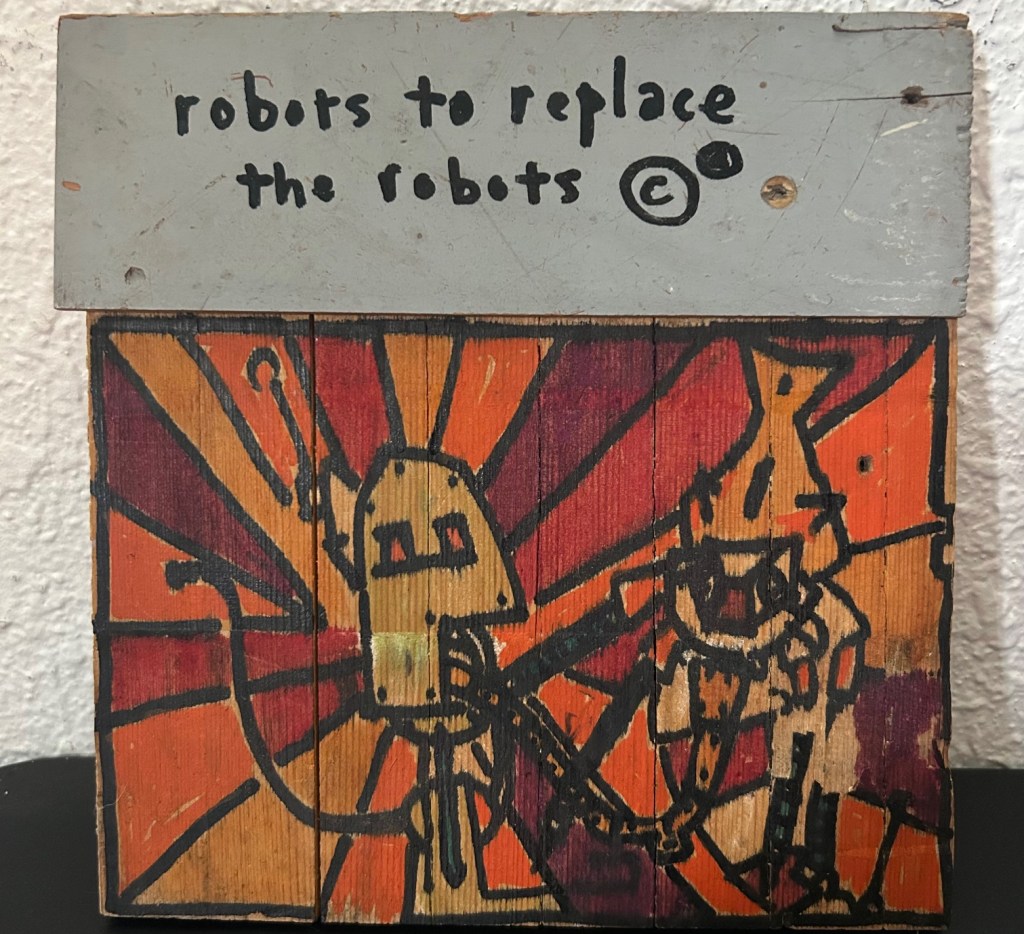
>>>>> Featured image: Original artwork, Aaron Peets. <<<<<
Once, when I was touring the soon-to-be-reopened Burke Museum of Natural History, gathering information for a feature in Seattle magazine, I noticed a group of archaeologists chipping away at a giant rock. A friendly face among them waved and invited me into the lab where they were working. A step stool was produced, and I was told to climb to the top and stick my head in the hole they were excavating. That’s when I saw a pointy tooth, then lots of teeth, the length of my fingers, and realized I had stuck my head into the petrified skull of a pre-historic T. Rex.
I was filled with awe. How 70 million years on the planet have passed since dinosaurs ruled. And there I was, a minuscule speck in the Anthropocene, with the ability to contemplate such a thing. My tiny, human-sized brain struggled to grasp such a gulf of time, and the fossilized remains it left behind.
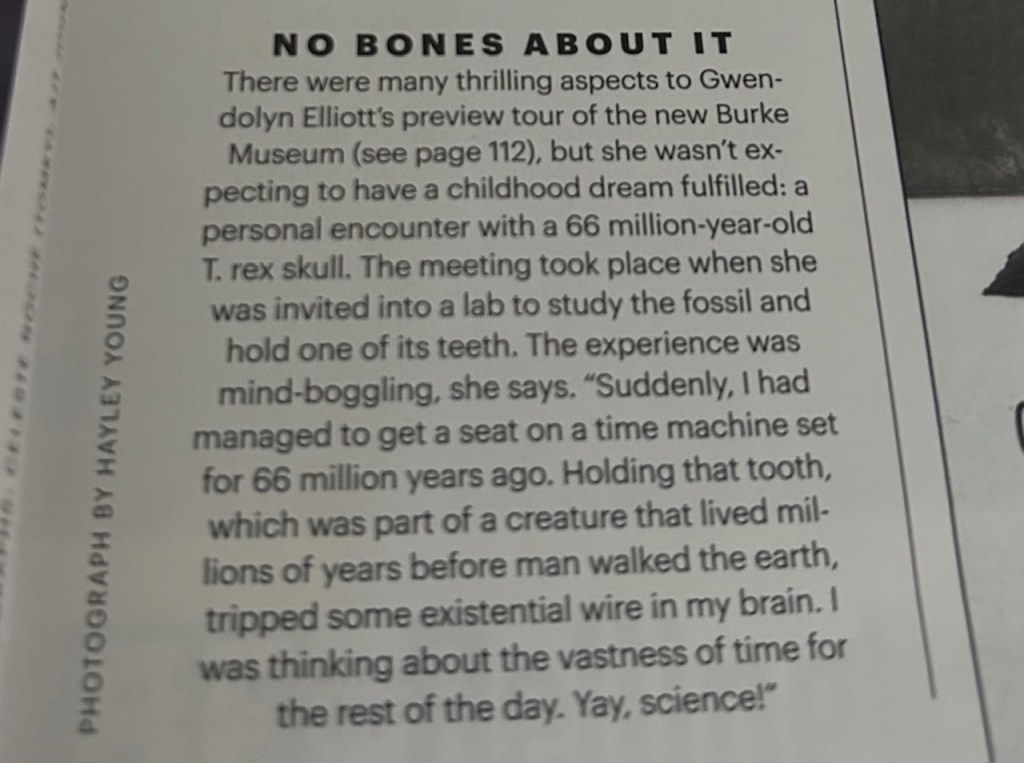
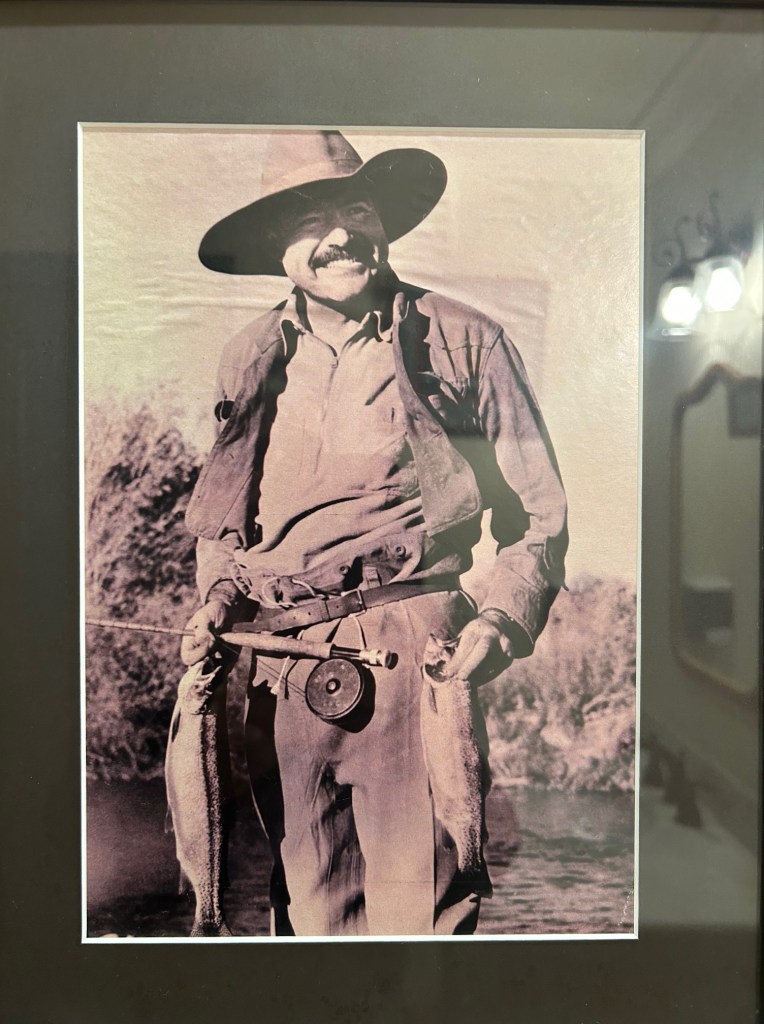
A similar sensation arose in me again as I stood in the presence of another stony relic last month: Ernest Hemingway’s large headstone in Ketchum, Idaho.
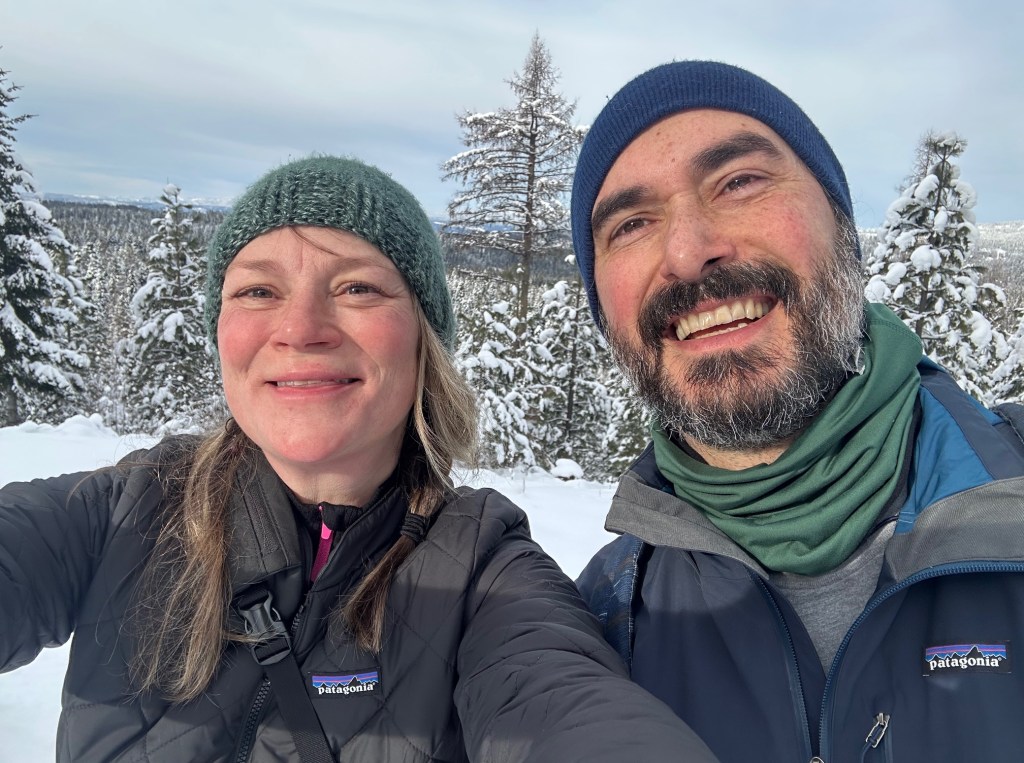
I was fresh off the hardest set of black diamond Nordic trails I had ever attempted (the name of one: “Psycho”), and felt like a pile of mush. The small cemetery was conveniently located on the main highway back to town, and Toby and I figured the gravesite, a pilgrimage for his devotees, would be easy to find (it was). It was a quick stop on the way back to the hotel before the après ski we promised ourselves after all our huffing and puffing.
As I looked down on Hemingway’s grave, again, I contemplated time. The writer was one of my favorite authors in my 20s. I admired his concise prose, a style he developed from his work as a news reporter. Just the right word, just the right place, and nothing more. Except for all that was between the lines—oceans of feeling I could sense, or didn’t quite recognize, or understood right away. I was in awe of his verve, and powerful storytelling.
I was just as fascinated by his boho Parisian life, bellied up to a bar or a bistro table, surrounded by writers; his thirst for adventure and travel; his blunt opinions and vast conversations; his overall gusto for experience (not to mention cats)—I studied up on his life and devoured all his major works. I didn’t linger on the problematic aspects—his misogyny, racism, and relentless exploitation of animals—at the time, longing for my own life of adventure, I was absorbed by his indefatigable pursuits.
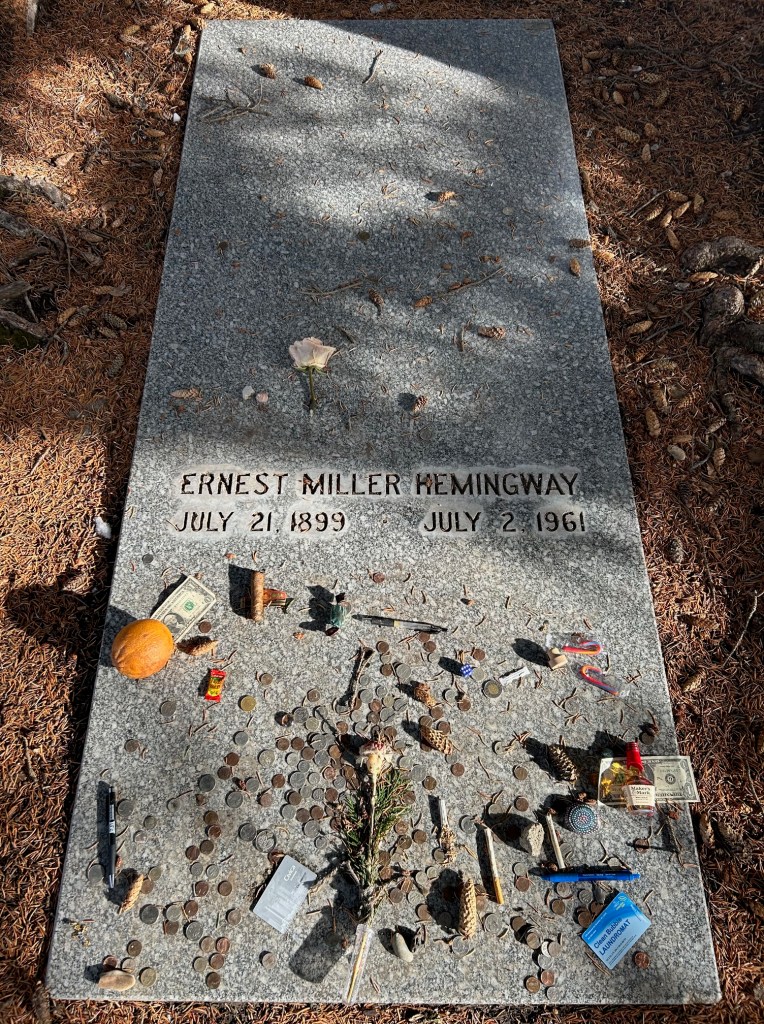
My admiration shifted as I gained more life experience and discovered other authors, though at the foot of his grave I remembered anew that his influence was specific to a particular time of my life. All of that seemed irrelevant, however, in the minutes I hovered over his final resting place. Between the living and the dead, I wondered who the dinosaur was now.
Over the course of my career I’ve developed a particular skillset, opportunities for which today are about as promising as a new species emerging during a mass extinction event. I’m no Hemingway, but at least in his time, if you had the talent and drive, you could make a living as a reporter and writer. There was demand for news stories. Newspapers provided a real, desired, and vital public service, and were read widely. At the same time, people drank alcohol, and few (excepting the teetotalers) questioned wine’s historical importance, and cultural value.
Today we have influencers, sponsored content, misinformation, “alternative facts,” the fast-creep of AI slop, and endless journalism layoffs. We have neo-prohibitionists, self-righteous political and religious groups, and multiple generations so obsessed with the pursuit of “wellness” that they believe a single drop of wine is poison. We have a population on appetite-suppressing drugs who have lost the thirst for wine, and an increasingly high cost of living that has turned it into an expendable item.
No one wants to read another article bemoaning the death of the news industry, or the many struggles the wine business is facing. But what else am I supposed to do with my particular background? Pivot to influencing and self-promotion? Go into sales? Even more pitiful, should I keep writing about wine as a freelance writer—and hemorrhage our savings in the process? The pay is so pathetic and unpredictable, I haven’t been able to crack the code to anything that even remotely resembles a living.
In Death in the Afternoon, Hemingway wrote that “wine is one of the most civilized things in the world and one of the natural things of the world that has been brought to the greatest perfection, and it offers a greater range for enjoyment and appreciation than, possibly, any other purely sensory thing which may be purchased.”
As Instagram serves up endless unboxing videos and influencers schlepping the latest sponsored product, this breathless ode sounds like an echo from an ancient civilization.
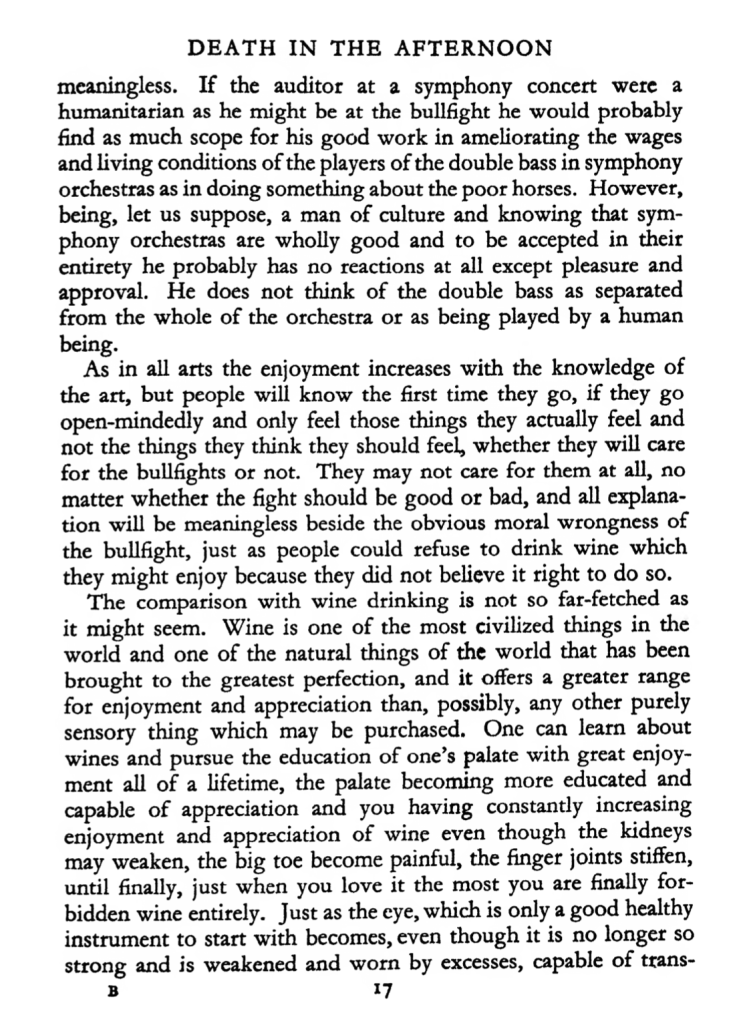
The culture of wine has long connected humanity, and as we lose it, we lose ourselves. Just as we lose ourselves when we accept that information, news, and storytelling is better delivered, or simply more entertaining, as a marketing campaign, advertisement, or piece of “content” (the word our consumer culture loves to use to commodify creative work).
A recent article, “The Lost Art of Sharing a Bottle,” briefly plunged me into despair. We’ve reached the point, the author argues, thanks to Covid and the seduction of technology, a fear of intimacy, an unwillingness to spend unstructured time with another person, and an inability to share (a bottle of wine as opposed to getting “your own glass”), that sharing a bottle has become a “lost art.” (Another article, “How humankind’s 10m-year love affair with booze might end,” reflects on similar themes.)
When the wine industry is gone, and cultivated grapevines have returned to the wild, what elemental product, so tied to vintages and calendar dates, the unique soil and soul of a place, and the work of centuries of generations and millions of human hands, will be able to snap us back to attention, to remind us of our shared humanity, to fully grasp the passing of time?
When all the writers are gone and out of work, who will tell the story of all that has transpired in our world, all the small pleasures, spontaneity, and joy of everyday living that have been sucked up between the lines of a developer’s code? Should we leave that to AI to ponder, too—or the Hemingway bot, whenever this makes its eventual arrival?
It is depressing to think that society is too distracted, too stimulated, and too busy to care what happens. Yet for someone like me, my professional failures have kept me on constant alert.
I am a human writer. I don’t use AI or Chat GPT. Fundamentally, I can not even bring myself to consider it. I learned how to write the hard way, fighting and grasping for every word, doubting myself and my choices at every turn, learning from terrible decisions and hard-earned wins. I do not believe that the answers to my deepest questions, my struggles as a writer, my sadness at the loss of our shared culture, will be discoverable at the click of a button, or via an algorithm goading me to scroll an infinite feed of inputs (surely making a cohort of technocrats richer each time).
No, the answers, wherever they are, will be hard to find. It’s life I want to be living, after all, and life fundamentally is a place where answers are hard to find. I am not interested in the artificial version, as difficult and inconvenient this has made things for me.
Meanwhile, I fossilize. I sense the real doomsday asteroid isn’t a fireball from the sky, but the endless strings of Javascript, Python, and SQL automating human ingenuity into oblivion.
I wonder if the dinosaurs could feel it, the change that was coming.


 Gwendolyn Elliott
Leave a reply to Ellis Conklin Cancel reply